

Planetary health, a transdisciplinary field focused on understanding and addressing the interdependencies between human health and the state of Earth’s natural systems, has rapidly gained traction since its formal articulation by the 2015 Rockefeller Foundation–Lancet Commission (Whitmee et al., 2015).
Planetary health is not merely theorized, but lived and practiced.
However, the mainstream development of planetary health remains disproportionately shaped by institutions and epistemologies of the Global North. This has led to frameworks that, while aspiring to universality, often overlook the deeply embedded ontologies, lived experiences, and local governance systems of the Global South. Yet it is precisely in these contexts—shaped by colonial histories, ecological precarity, and socio-environmental resilience—that planetary health is not merely theorized, but lived and practiced.
Across the forests of the Amazon, the deltas of the Mekong, the savannahs of East Africa, and the islands of the Pacific, alternative narratives of planetary health persist—narratives grounded in relationality, community stewardship, Indigenous knowledge, and intergenerational responsibility. These are not peripheral stories. They are foundational to any truly global understanding of planetary health.
Planetary Health from the Ground Up
In Indonesia, the centuries-old subak irrigation system represents a deeply embedded socio-ecological infrastructure that integrates not only agricultural productivity and water management, but also Balinese spiritual cosmology and communal governance. The tri hita karana philosophy—centering harmony among people, nature, and the divine—underpins this system, offering a relational ontology wherein ecological and spiritual health are inseparable. Similarly, in the Sahel region, transhumant pastoralism exemplifies an adaptive strategy to climatic unpredictability rooted in sophisticated ecological knowledge, mobility regimes, and inter-ethnic reciprocity systems. These modes of existence challenge sedentary and static assumptions about land use and highlight the political ecology of movement as survival.
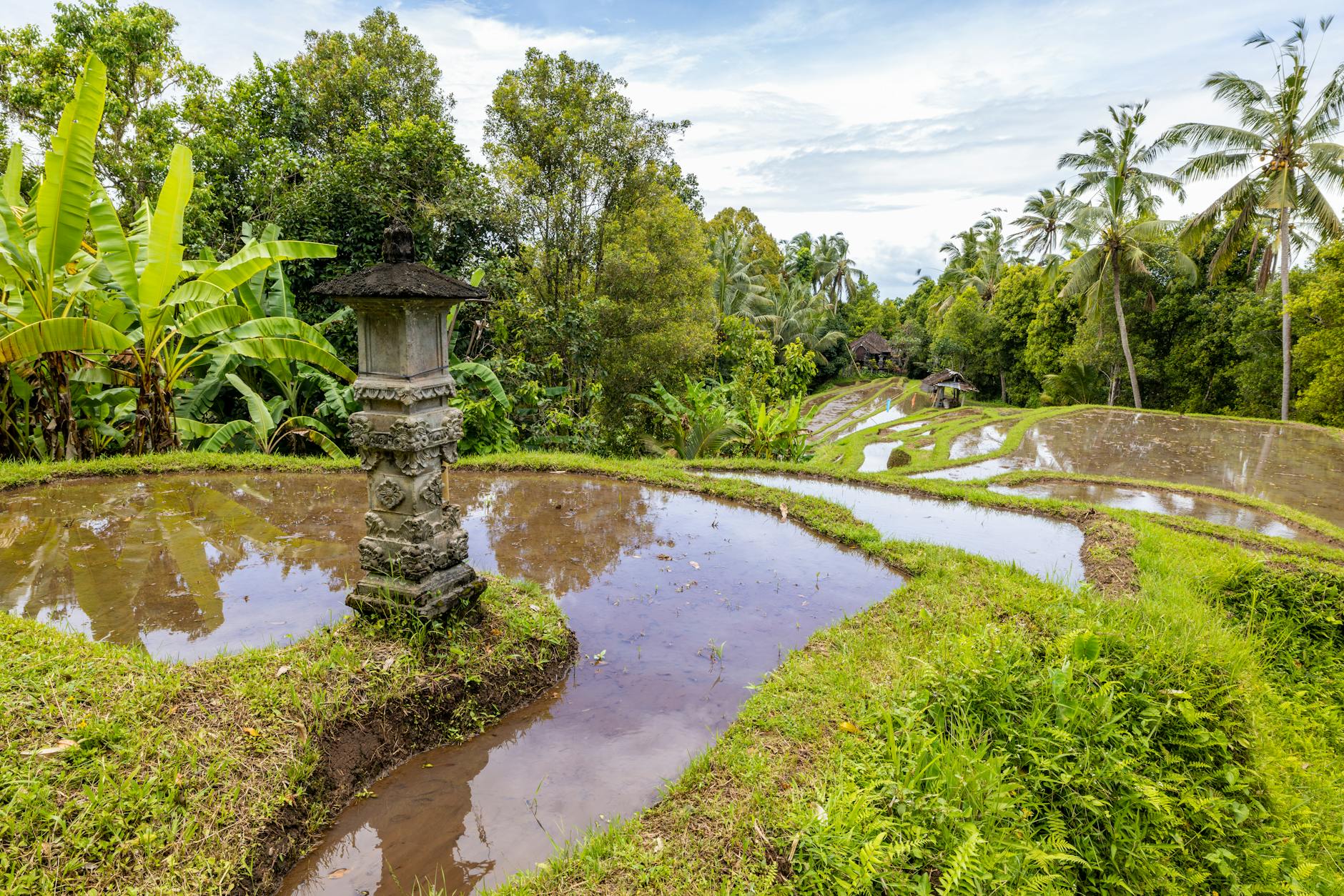
The Subak System in Bali, Indonesia. (Photo by Balazs Simon on Pexels.com)In Bangladesh and rural India, grassroots public health movements—such as those led by women’s health collectives—embody a biopolitical praxis that combines sanitation infrastructure, biodiversity stewardship, and community-based health care. These initiatives foreground gendered labor as central to environmental health and resist reductive, technocratic approaches by embedding care, agency, and ecological ethics within everyday health governance.
Likewise, Latin American philosophies such as Buen Vivir and Sumak Kawsay—deeply rooted in the ontological foundations of Indigenous Andean worldviews—construct a relational cosmopolitics in which human life is inextricable from the vitality of the non-human world. These frameworks advance a critique not only of neoliberal economic rationality but of the anthropocentric epistemologies that underpin dominant models of development and health governance.
Rather than offering a cultural ‘alternative,’ these paradigms represent robust ontological systems with their own logics of governance, ethics of care, and metrics of well-being—ones that resist commodification and displace the centrality of the sovereign, bounded human subject. Their persistent exclusion from planetary health discourse underscores a profound form of epistemic violence, wherein Western science positions itself as both arbiter and beneficiary of global knowledge production.
This involves re-centering Indigenous frameworks such as Buen Vivir not as adjuncts to global health discourse, but as generative foundations for alternative planetary futures, capable of redefining what it means to live well—in relation, not domination.
To actualize planetary health as a truly transformative and just endeavor, it is imperative to move beyond tokenistic inclusion toward a radical epistemic reconstitution. This involves re-centering Indigenous frameworks such as Buen Vivir not as adjuncts to global health discourse, but as generative foundations for alternative planetary futures, capable of redefining what it means to live well—in relation, not domination.
Throughout the Global South, local actors are not passive recipients of planetary crises—they are proactive agents of resistance and restoration. In the Amazon, Indigenous federations lead conservation efforts that protect biodiversity while safeguarding public health through the stewardship of forests, rivers, and food systems. In the Philippines, Bayanihan traditions mobilize mutual aid in response to climate disasters, integrating social resilience with ecological wisdom. Across Africa, women-led agroecological cooperatives rebuild degraded soils and secure food sovereignty through practices that defy extractive agribusiness models.
In the Amazon, Indigenous federations lead conservation efforts that protect biodiversity while safeguarding public health through the stewardship of forests, rivers, and food systems.
These practices demonstrate that Indigenous and local knowledge systems are not merely valuable for cultural diversity—they are functionally critical to planetary survival. Framing them as ‘alternative’ only perpetuates a colonial hierarchy of knowledge. Instead, these systems must be recognized as exercises of sovereignty and world-making, deeply embedded in place-based ontologies that prefigure the kind of sustainability planetary health aspires to achieve.
Case Study: The Blue Mountains, Australia
An illustrative example from the Global North that resonates with southern epistemologies is the City of Blue Mountains in New South Wales, Australia. A UNESCO World Heritage site with a strong tradition of environmental consciousness, the region has faced compounding ecological crises—from the devastating 2019–20 bushfires to successive flooding and pandemic disruptions.
In response, the Blue Mountains City Council (BMCC) launched a Planetary Health Initiative in 2021, becoming one of the first municipal governments to embed planetary health into local sustainability governance. This initiative not only addresses climate adaptation but institutionalizes participatory planning frameworks that bridge scientific expertise with community-driven knowledge systems. As part of the BMCC’s expanding vision, the Initiative is now leading a comprehensive Disaster Risk Reduction (DRR) program designed to align with the principles of planetary health.
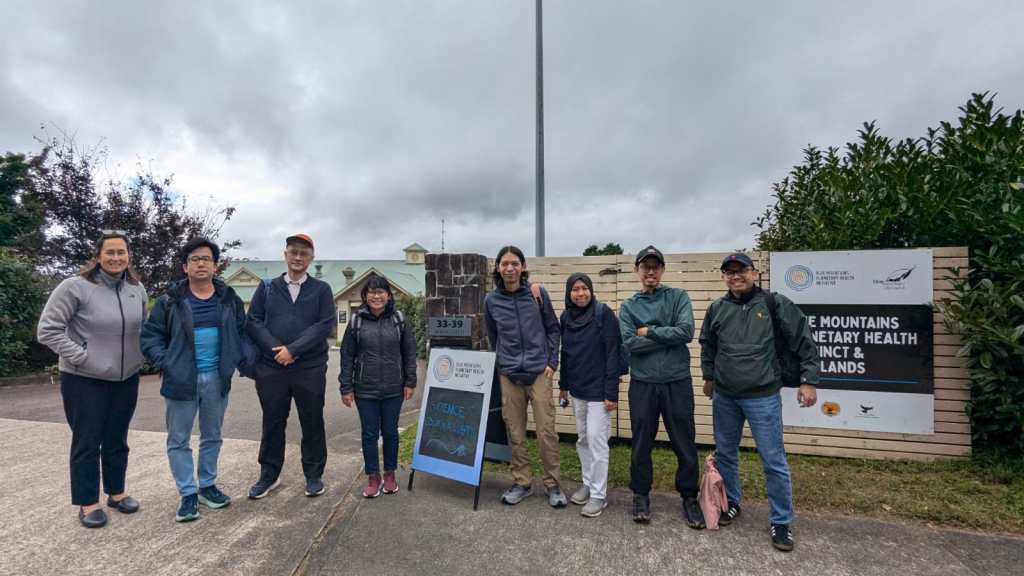
The SciCoPH team recently (8/4) visited the Blue Mountains Planetary Health Initiative, Katoomba, Sydney.This DRR program emphasizes systemic resilience rather than reactive emergency management. It incorporates community-led bushfire preparedness, climate-adaptive infrastructure, and culturally informed mental health support. The Initiative has championed the integration of Indigenous knowledge into disaster response strategies, auspicing a Dharug initiated cultural burning program.
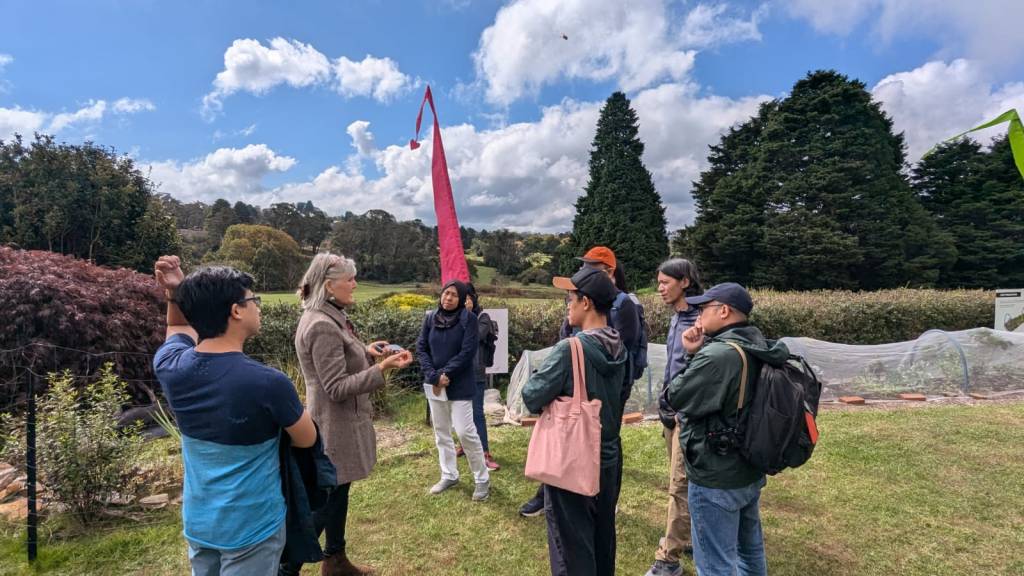
Learning about the landscape and vulnerability of Katoomba and Blue Mountains, and the importance of the natural water catchment ecosystem of the swampA 2022 study by Eleanor Robson et al. conducted in the Blue Mountains LGA sought to explore how the abstract yet critical discourse of planetary health resonates within the everyday lives of community members. Drawing on the IPBES Assessment of Diverse Values of Nature, the research unearthed a spectrum of relational and ontological framings through which residents made sense of their embeddedness within the biophysical world. These framings were not merely descriptive categories, but interpretive frameworks shaped by history, emotion, cultural memory, and lived ecological experience.
Living in nature emerged as the most dominant articulation. It conveyed a profound emotional, psychological, and communal attachment to place, signifying not just aesthetic appreciation but a psychosocial dependency on ecological stability for identity, healing, and resilience. Participants described the forests, escarpments, and birdlife of the Blue Mountains as vital sources of existential continuity, particularly in the wake of cascading environmental shocks. This view positions the natural environment not only as a passive backdrop but as an active co-therapist and repository of affective restoration. It reflects an eco-phenomenological orientation in which place itself becomes therapeutic.
- Living from nature reflected more utilitarian and survival-based logics, particularly salient among residents who had endured recent bushfires and floods. Nature here is understood as a life-sustaining infrastructure—providing air, food, water—yet precariously vulnerable to disruption. This instrumental view was nuanced by layers of vulnerability and critique: residents expressed anxiety over climate-induced scarcity, distrust in political leadership, and a heightened awareness of ecological interdependence. In this framing, planetary health is seen as a vital systems function, with disruptions bearing uneven impacts that reinforce structural inequalities, particularly for those on the socio-economic margins.
- Living with nature captured ethical commitments to multispecies coexistence, rooted in moral and spiritual imperatives to respect and protect non-human life. This framing resonated with post-humanist sensibilities and often evoked Indigenous custodianship ethics, where flora, fauna, and landforms are perceived not as inert matter but as kin, elders, or active participants in community life. Participants referenced cultural burning practices, water spirit stories, and shared grief for species loss as part of a broader relational ontology. Here, planetary health extends beyond human survival to include the flourishing of the more-than-human world as a moral imperative.
- Living as nature emerged among a smaller cohort but held radical implications. It articulated a pluricentric ontology in which the boundary between human and environment dissolves. Participants who expressed this worldview often drew from deep ecology, spiritual ecology, or First Nations philosophies, describing humans as one modality of Earth’s self-awareness. This aligns with perspectives advanced by scholars such as Vandana Shiva, particularly in works like Staying Alive (1988) and Earth Democracy (2005), where she critiques mechanistic worldviews and emphasizes the sacredness of ecological interbeing, and Arturo Escobar, notably in Designs for the Pluriverse (2018), where he advocates for a pluriversal approach to sustainability grounded in relational ontologies. In this frame, planetary health is not merely a condition to be achieved but an ontological truth to be lived. The implications are profound: governance, policy, and care must recognize the inseparability of human and planetary vitality.
Together, these framings complicate simplistic dichotomies of human versus nature and challenge managerialist approaches to sustainability. They reveal a layered and dynamic set of relationships that inform local planetary health imaginaries—relationships shaped by grief, intimacy, care, resistance, and hope. The study underscores the need for planetary health governance to be reflexive, culturally attuned, and rooted in the lived moral geographies of place. It also highlights the epistemic richness of localized narratives, which offer counterpoints to universalist framings and foreground the necessity of grounding planetary solutions in plural, place-based worldviews.
Findings revealed gendered and generational differences in environmental engagement. Women were more likely to express relational values and undertake household-based environmental actions, while older residents favored advocacy, and younger people gravitated toward conscious consumption. Critically, residents expressed dissatisfaction with current policy leadership and called for trauma-informed, community-empowering governance.
The Blue Mountains case illustrates how planetary health can be localized, decolonized, and made responsive to lived realities. It demonstrates that planetary health frameworks are most effective when they emerge from, and are co-designed with, communities themselves.
Rewriting Planetary Health: From North to South and Back Again
To realize a planetary health paradigm that is truly pluralist, emancipatory, and decolonial, we must enact structural, epistemic, and ethical shifts that interrogate the coloniality of current global health systems.
The resonance between Global South epistemologies and emerging Northern experiments like the Blue Mountains Initiative suggests not a unidirectional transfer of knowledge, but the possibility of dialogical co-constitution. To realize a planetary health paradigm that is truly pluralist, emancipatory, and decolonial, we must enact structural, epistemic, and ethical shifts that interrogate the coloniality of current global health systems.
- From extraction to co-production: The historical tendency of the North to extract data, knowledge, and labor from the South must be superseded by collaborative models of co-production that prioritize mutual respect, long-term relationship-building, and reparative justice. This means centering Southern institutions in research design, authorship, agenda-setting, and governance—transforming planetary health from a framework of intervention to one of co-creation. Co-production is not a methodological add-on; it is a political stance that contests the epistemic hierarchy long sustained by global health.
- From universalism to epistemic pluralism: The illusion of a universally applicable planetary health model, abstracted from context, must give way to a deep appreciation of diverse ontologies and epistemologies—many of which may be incommensurable with dominant scientific paradigms. This requires embracing not only cognitive justice but ontological openness: an acknowledgement that notions of health, ecology, and life itself vary profoundly across cultures. Planetary health must become a polyvocal field, welcoming insights from animist, relational, and pluriversal worldviews that resist reduction to mere inputs for policy.
- From technocracy to ethical praxis: A planetary health framework centered solely on metrics, risk assessments, and biomedical indicators is insufficient to respond to the moral and existential stakes of the Anthropocene. What is required is an ethical praxis grounded in solidarity, humility, and care. This entails engaging with the affective and historical dimensions of planetary suffering—listening to the trauma, resistance, and resilience of communities who have long lived with systemic violence, environmental precarity, and exclusion. Ethical praxis demands moving beyond instrumental logic to cultivate shared responsibility for planetary flourishing.
These shifts are not merely conceptual—they require institutional transformation, political will, and a sustained commitment to justice. Planetary health, in this vision, becomes a space of negotiation, contestation, and repair: a collective project forged not through consensus, but through a plural, agonistic ethic of cohabitation on a damaged planet.
Next Action: A Shared, Situated Future
The Global South has long lived and the principles that planetary health now seeks to universalize. From subak (Lansing, 2007) to sumak kawsay (Gudynas, 2011), from agroecology in West Africa (Bezner Kerr et al., 2021) to cultural burning in the Blue Mountains (Costello & Yunkaporta, 2021), planetary health is already being enacted in diverse and place-based ways.
Planetary health must become a relational, political, and ethical project—constructed with communities, not for them
The task is not to impose a singular narrative but to hold space for many. Planetary health must become a relational, political, and ethical project—constructed with communities, not for them. It must recognize that sustainable futures require not just systemic change, but epistemic humility, historical reckoning, and the centering of those who have always understood that the health of people and the planet are inseparable. Only by embracing this plurality—anchored in the lived realities and knowledge systems of the Global South and aligned with decolonial thought—can planetary health evolve into a truly global, just, and sustainable response to our shared, entangled crises.
References

Bezner Kerr, R., Madsen, S., Stuber, M., Liebert, J., Enloe, S., & Snapp, S. (2021). Participatory agroecological research on climate change adaptation improves smallholder farmer household food security and dietary diversity in Malawi. Frontiers in Sustainable Food Systems, 5, 587157.

Costello, L., & Yunkaporta, T. (2021). Indigenous fire management and cultural renewal. Australian Journal of Environmental Education, 37(1), 26–42.

Gudynas, E. (2011). Buen Vivir: Today’s tomorrow. Development, 54(4), 441–447.

Lansing, J. S. (2007). Priests and programmers: Technologies of power in the engineered landscape of Bali. Princeton University Press.

Robson, E., Chong, J., Curtis, A., & Bastian, L. (2024). Planetary health values and their implications for sustainability governance: Case study in the City of Blue Mountains, Australia. Environmental Science & Policy, 150, 102115.

Shiva, V. (1988). Staying Alive: Women, Ecology and Development. Zed Books.

Shiva, V. (2005). Earth Democracy: Justice, Sustainability, and Peace. South End Press.

Whitmee, S., Haines, A., Beyrer, C., Boltz, F., Capon, A. G., Ferreira de Souza Dias, B., ... & Yach, D. (2015). Safeguarding human health in the Anthropocene epoch: report of The Rockefeller Foundation–Lancet Commission on planetary health. The Lancet, 386(10007), 1973–2028.

Escobar, A. (2018). Designs for the Pluriverse: Radical Interdependence, Autonomy, and the Making of Worlds. Duke University Press.
 ScienceWatchdog.id
2 thoughts on “Invisible Narrative of Planetary Health in the Global South”