
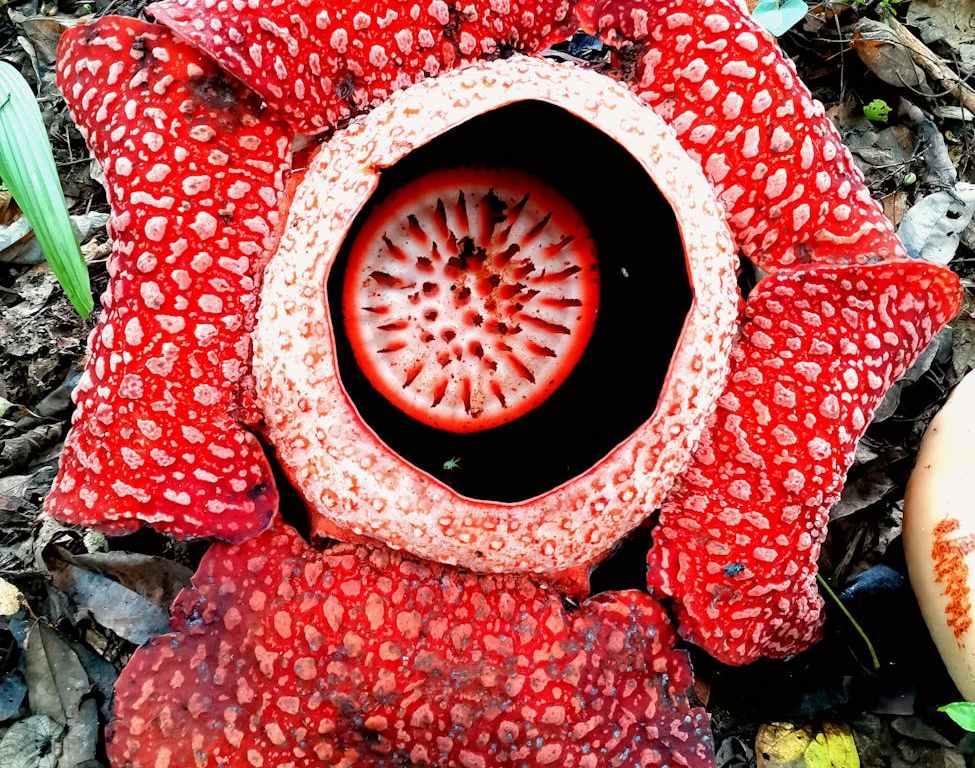
A rediscovery of the rare Rafflesia hasseltii in West Sumatra has sparked an unexpected debate over how international institutions frame conservation stories, who receives scientific credit, and how Global South researchers are represented in global media ecosystems. While the University of Oxford’s press and social media materials have circulated widely, scientists and netizens in Indonesia argue that the narrative structure used by international media reinforces imbalances that echo older colonial patterns in science communication.
The rediscovery itself is remarkable. Rafflesia, famed for being among the largest flowers on Earth and celebrated in Indonesian ecotourism materials like the Sumatra Ecotravel profile of Rafflesia Tour, blooms rarely and unpredictably. The species is known for its forest floor eruptions, huge red petals, and strong scent that attracts insects. On ecological grounds alone, the recent encounter in West Sumatra deserves international attention. What followed was a communication split. It highlights global scientific inequality as much as it does the flower itself.

Sources: Plants, Peoples, Planet (https://nph.onlinelibrary.wiley.com/doi/10.1002/ppp3.10431)
Oxford Sets the Narrative Tone Through a Familiar Storyline
Oxford’s formal press release on extinction risk, published earlier, established a pattern that would be repeated in later rediscovery news. It announced that “an international group of scientists, including botanists at the University of Oxford’s Botanic Garden, has issued an urgent call” to conserve Rafflesia. This phrasing names only Oxford, while subsuming Southeast Asian scientists into a broad, unnamed international group. Although the scientific article on which this news report is based clearly shows that the research was led and conducted primarily by scientists from the Philippines, Indonesia, and Malaysia, the Oxford public text presents Chris Thorogood as the main spokesperson and the figure who holds scientific authority in its narrative. The paper itself, “Most of the world’s largest flowers (genus Rafflesia) are now on the brink of extinction,” Pastor Malabrigo Jr. and Adriane B. Tobias are listed as the first and second authors, while other authors are from the University of the Philippines Los Baños, Indonesia’s National Research and Innovation Agency (BRIN), Bogor Botanical Gardens, University of Bengkulu, and Forest Research Institute Malaysia. The Author Contributions section also shows that Southeast Asian researchers wrote most of the country-specific content, compiled distribution data, and produced scientific figures. Yet none of these appear in the Oxford press release as scientific authorities.
This asymmetry became more pronounced when Oxford posted a video of the rediscovery of Rafflesia Hasseltii on Instagram. In the initial version (they edited the new caption on Instagram after) of the caption, the description focused on a trek through “tiger patrolled rainforests” without naming Septian Andriki, even though he is the Indonesian field botanist who mapped the site, guided the team, and spent more than a decade searching for the species. Within that framing, Chris Thorogood again appeared as the principal narrator, interpreting the scientific meaning of the event, while Septian Andriki was shown only as a team member without a clearly defined identity. His full identification was added only after Oxford revised the Instagram caption, a correction that underscored how the original framing had already downplayed his expertise.
International media adopted the Oxford phrasing wholesale. Greek Reporter’s coverage repeats the Oxford description almost verbatim, stating that the team included “Dr. Chris Thorogood of the University of Oxford” and that the flower is “seen more by tigers than people”. The New York Post focuses on the emotional moment, reporting that “flower hunter Septi Deki Andrikithat was seen sobbing with joy,” before quoting Thorogood’s perspective on the trek. The scientist from Oxford becomes the analytic voice, while the Indonesian botanist becomes an emotive figure. This contrast between who is allowed to interpret and who is posed as a witness exemplifies a representational pattern critics associate with “parachute research”.
But, International, Indonesian media, and BRIN tell a different story..
Regarding Rafflesia research from 2023, global science news outlets, such as EurekAlert, have replicated the Oxford message almost verbatim. These sites often serve as primary sources for journalists, meaning the Oxford framing becomes the default international narrative. Phys.org and the Global Plant Council likewise reproduce the text nearly unchanged. Specialist blog Botany One did the same. Once these narratives circulate through English-language media, alternative frames are pushed to the margins. This difference shapes the international public imagination; Rafflesia becomes a story of Oxford’s scientific presence in a remote forest rather than a tale of Indonesian stewardship and Southeast Asian scientific leadership. Once distributed across global platforms, the press release creates the impression that Oxford is the scientific center of the work, even though Southeast Asian institutions generated the foundational data.
Insert: Media Reinforcement, Global Information Flows, and the Problem of Churnalism
In coverage of the Rafflesia research, global information flows overwhelmingly amplified the institutional framing produced by Oxford. Major science news aggregators such as Phys.org, the Global Plant Council, and ScienceDaily reproduced Oxford’s press release almost word-for-word, modifying only headlines or minor phrasing. Specialist outlets like Botany One followed the same pattern, centering Oxford’s quotes, imagery, and spokesperson while omitting or minimizing contributions from Southeast Asian researchers. Once these materials circulated through the English-language science news ecosystem, their repetition across multiple platforms consolidated Oxford’s narrative as the default international account. In contrast, frames that emphasize Indonesian stewardship, regional scientific leadership, or community-based conservation — including those articulated by BRIN — circulated primarily within local or regional media systems with far more limited global reach. The result is a skewed public imagination in which Rafflesia becomes a story of Oxford’s scientific expedition rather than a tale of Indonesian ecological governance and Southeast Asian research leadership.
A substantial part of this pattern is explained by churnalism, a term used to describe journalism that relies heavily on pre-packaged PR material rather than independent verification or reporting. In science journalism, churnalism is structurally entrenched because newsrooms face shrinking budgets, reduced specialist staff, and compressed production timelines. Research shows that a large share of science news stories replicate institutional press releases with minimal editing, meaning the voice and framing built into those releases are carried directly into public discourse. Lewis, Williams, and Franklin (2008) demonstrate how newsroom pressures incentivise journalists to “churn” press releases into copy with little contextualisation or scrutiny. Sumner et al. (2016) similarly found that exaggerations and interpretive distortions in science news often originate in the press releases themselves, illustrating how dependence on PR pipelines shapes public understanding of scientific work.
The uploaded systematic review of churnalism further strengthens this explanation. Brück, Knorr, and Guenther’s (2025) analysis synthesises twenty-five years of research and identifies churnalism as a routine feature of digital news production, sustained by what they describe as “verbatim or near verbatim reproductions of external third-party material” and “structural dependence on information subsidies provided by powerful institutions”. Their review notes that universities with strong communication infrastructures disproportionately shape news agendas because journalists rely on their ready-made narratives. It also highlights how churnalism tends to marginalise perspectives from actors with less PR capacity, including institutions in the Global South.
The Rafflesia case fits this model precisely. Oxford supplied a complete narrative package — polished visuals, well-crafted quotes, and an easily digestible storyline — that required little additional labour for journalists working under time pressure. BRIN’s framing, by contrast, required engagement with Indonesian conservation law, local institutional context, and regional ecological histories, material that is less accessible to reporters operating within Anglo-centric news structures. Consequently, the media ecosystem amplified the Oxford narrative and muted the Southeast Asian scientific and community context that underpins the research. This outcome did not depend on deliberate distortion. Instead, it emerged from the ordinary mechanics of contemporary science journalism, where churnalism and uneven PR infrastructures combine to elevate Global North voices and compress Global South expertise into the margins of international visibility.
Indonesian coverage presents the rediscovery in a different frame. The state news agency ANTARA reports that the bloom occurred in “kawasan Hiring Batang Sumi, Kecamatan Sumpur Kudus,” that the species is protected under national regulation PP No. 7/1999, and that the event underscores Indonesia’s responsibility to safeguard its endemic flora. ANTARA emphasises how the discovery of Rafflesia connects to conservation law, local ecology, and ongoing work by researchers embedded in the landscape.
Also, BRIN’s own press note frames the rediscovery as a matter of community-based conservation rather than an expedition story. Its headline centers BRIN scientists as key actors: “Peneliti BRIN Ungkap Temuan Rafflesia hasseltii di Sumatera Barat, Dorong Konservasi Berbasis Masyarakat.” (BRIN Researchers Reveal Discovery of Rafflesia hasseltii in West Sumatra, Encouraging Community-Based Conservation). Also on its most recent Instagram post, BRIN frames the rediscovery through an entirely different narrative lens. The post opens with the headline “Mekar di Hutan Nagari, Jejak Baru Rafflesia hasseltii” (Blooming in the Nagari Forest, New Traces of Rafflesia hasseltii), foregrounding place, local ecology, and Indonesian custodianship rather than the drama of an expedition. The caption situates the bloom explicitly within the forest of Hiring Batang Sumi in Nagari Sumpur Kudus and immediately emphasizes that the discovery is proof of the importance of collaboration between BRIN, universities, and local communities. Unlike Oxford’s adventure-driven tone, BRIN’s message highlights methodological rigor (“metode genom lengkap”), collective research capacity, and the essential role of community partners in maintaining fragile habitats to ensure Rafflesia’s persistence.
And then Indonesian netizens push back..
Public commentary in Indonesia sharply amplified this contrast. A widely circulated Instagram post by Neohistoria.id argued that international attention to Rafflesia is “terjebak dalam bias kolonial yang meresahkan” (trapped in disturbing colonial biases) and that global outlets “menyanjung Chris Thorogood sebagai tokoh sentral, seolah hutan tropis Indonesia adalah panggung kosong tanpa penjaga.” (praising Chris Thorogood as a central figure, as if Indonesia’s tropical forests were an empty stage without a guardian). In this content, Neohistodia.id said that international reporting sidelines Indonesian scientists such as Joko Witono, Septi Andrik, and Iswandi, whose long-term field expertise enabled the rediscovery. Their absence is not treated as a minor editorial oversight but as an instance of epistemic injustice that artificially separates Western “discoverers” from Southeast Asian “guides,” despite the fact that both sets of actors generated the scientific knowledge on which the study depends.
The critique gains further weight when compared with the scientific paper itself. The underlying study is not a top-down Northern initiative but a synthesis grounded in regional research infrastructures. Southeast Asian scientists provided the majority of species distribution data, documented habitat decline, designed propagation experiments, ran monitoring programs, and developed ecotourism-based governance models. The paper assesses extinction risk for 42 species, estimates that roughly 60 percent fall within severe threat categories, and notes that two-thirds of known habitats occur outside protected areas. It also highlights community-based initiatives in West Sumatra and propagation successes at Bogor Botanic Gardens. Within the scientific record, researchers from the Philippines, Indonesia, and Malaysia are clearly positioned as knowledge producers. In Oxford’s press release, however, they reappear only as local informants or unnamed contributors.
The discrepancy is not only a matter of attribution. Research on conservation communication shows that visibility shapes which institutions influence agendas and how problems are framed. Pritchard and colleagues demonstrate that when Global North institutions dominate communication, conservation priorities tend to mirror Northern perspectives. Valdez and collaborators show that marginalising Southern scientists reduces the epistemic diversity essential for robust biodiversity policy. These issues are especially acute in the case of Rafflesia, where conservation is entangled with Indigenous land relations, community-based ecotourism, and local safety considerations. When Oxford’s framing minimises the scientific identities of Southeast Asian institutions, it inadvertently reproduces structural imbalances familiar from tropical ecology and coral reef research. The pattern recurs: local experts appear as emotional witnesses or stewards of the landscape rather than as analysts whose conceptual frameworks define the conservation challenge in the first place.
At the Heart of the Issue
A more balanced approach is possible. Oxford’s communication could prominently name Southeast Asian researchers, identify BRIN and other partners directly, and present Thorogood as one contributor among many. Quoted statements could include Malabrigo, Tobias, Witono, or Andrikithat, and other local contributors. Visual materials could more clearly acknowledge local institutions. Story structures could emphasise collaboration rather than adventure.
Conservation research supports these changes. Asase and colleagues argue for replacing “parachute science” with global science in which collaborators across regions share authorship and communication roles. Also, Susan Baker and Natasha Constant’s analyses highlight the importance of epistemic justice in integrating local knowledge. Media scholars note that biodiversity reporting shapes policy agendas. These are not peripheral considerations. They influence which ecological priorities matter.
Rafflesia conservation is collaborative. It is built on the knowledge of Southeast Asian scientists, community monitors, ecotourism groups, and forest-based actors who protect habitats year-round. The rediscovery is a scientific event, but it is also a social and political moment. Who speaks for that moment shapes who is recognised as a scientific authority and who is acknowledged as a guardian of one of the planet’s most extraordinary flowers.
The Oxford framing has reached global audiences. The BRIN framing may not get the same scale, but it offers a corrective grounded in the national context. As debates over “parachute research” continue, the Rafflesia case illustrates how communication choices can either reinforce old hierarchies or create space for a more accurate and equitable representation of global biodiversity science. If conservation is to be genuinely global, its narratives must reflect the full landscape of knowledge production, not only the institutions with the most powerful megaphones.

 ScienceWatchdog.id
Be honest in science. Don’t admit it alone if it is the result of a joint discovery